
QC LIMS Software — the CORPEX LIMS Samples & QC Testing Module
Quality control LIMS for pharmaceutical labs: sample management, results against specification, OOS investigations and controlled certificates. Available on its own or as part of the CORPEX LIMS platform.
What the Samples & QC Testing Module Does
The Samples & QC testing module is the QC LIMS of the CORPEX LIMS platform for pharmaceutical manufacturers, for managing raw materials, in-process items, and finished goods through the production process, from material registration to final product release.
It organizes the QC laboratory's core activities, including methods of analysis, certificates of analysis, product specifications, and statistical process control, and is designed to compliance standards including FDA, WHO GMP, ISO, and 21 CFR Part 11. It's built for the QC manager who has to answer, on demand, exactly which instrument produced a given result and who reviewed it.
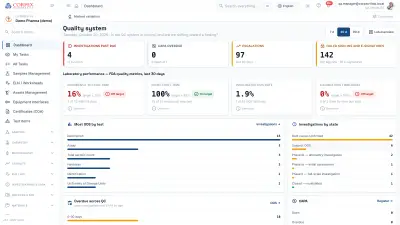
Who Uses This QC LIMS
Any pharmaceutical, food, or chemical QC lab running the same panel of tests against specification, batch after batch, is the intended user: raw-material testing before goods reach the line, in-process checks during manufacturing, and finished-product release testing before a batch can ship. The module captures, organizes, and manages that test-execution workflow across the lab, letting staff track the sample lifecycle, run the lab's calculations, interface instruments, and keep the security and audit trail a QC release decision depends on.
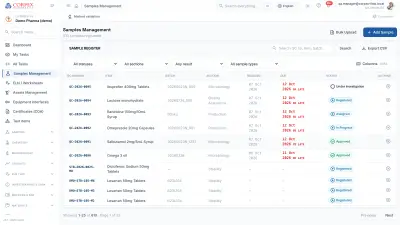
Samples Management
The main function of a LIMS is managing sample receiving, distribution, tracking, and reporting. CORPEX LIMS also manages the resources around the sample: instruments, materials, product specifications, suppliers, reagents, and consumption.
- Sample login and tracking
- Resource management
- Barcode and label generation
- Sample tracking from receipt to release
Data Acquisition
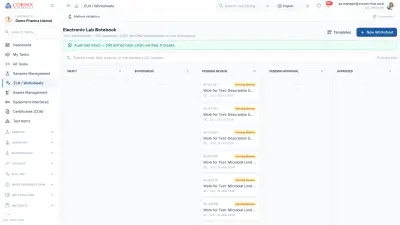
A modern QC lab generates a lot of instrument output. CORPEX LIMS captures instrument readings into ELN worksheets so that the number stored against a sample is the number the instrument produced, not a value re-typed from a printout.
Capture refuses wrong units and out-of-calibration instruments, and any override needs a recorded reason. That cuts out the manual transcription errors that a 21 CFR Part 11 or GMP audit is specifically designed to catch, and it protects the data integrity a lab's reputation and its release decisions both depend on.
The Compliance Requirement Behind QC Release
Why a QC lab can't run this on spreadsheets alone.
FDA 21 CFR Part 11 requires that electronic records used to support a batch release be as trustworthy as paper: every entry needs a timestamp, every change needs a documented reason, and every electronic signature has to tie back to one specific, authenticated person, not a shared login. WHO GMP and EDA GMP expectations layer on top of that: raw data has to be retained, and the record has to make it possible to reconstruct exactly how a batch was tested.
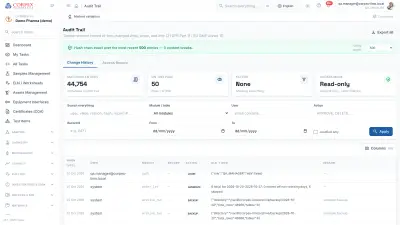
The CORPEX LIMS audit trail is built around that requirement: every change is written to a hash-chained, tamper-evident log so a reviewer or inspector can verify who entered a result, when, and what happened to it afterward. The data-integrity discipline underneath is ALCOA+: attributable, legible, contemporaneous, original, and accurate, applied as a default rather than a manual check.
Analysis Calculations
Calculation worksheets for the standard pharmacopoeial tests a QC lab runs every day, so results are calculated in the system rather than in a separate spreadsheet:
- Standard agreement by HPLC and UV
- Assay by HPLC, titration, UV and bioassay
- Dissolution by HPLC and titration
- Disintegration and average weight
- Microbial limits and sterility tests
Investigations, Trending, and Resource Control
What happens once a result comes back, and how the lab's own resources stay under control.

Controlled Certificates
A Certificate of Analysis cannot print before release. The first copy is controlled, and every reprint is marked uncontrolled with a recorded reason.

Investigations
Out-of-specification values are flagged at result entry; at review they are raised as OOS investigations, worked through their phases and linked to CAPA.
Audit Trail
A hash-chained, tamper-evident audit trail that shows who changed what, when and why, and verifies that the chain is intact.
Consumables Management
CORPEX LIMS monitors consumable levels, reagent usage, and stock, so budget decisions are based on organized inventory data rather than a shelf count.
Assets Management
Lab equipment records cover calibration, maintenance, and performance monitoring for the instruments the lab's results depend on.
How a Batch Moves Through CORPEX LIMS
From material registration to a signed certificate of analysis.
Registration and specification check
A raw material, in-process sample, or finished-product batch is registered against its product specification. The system already knows which method of analysis (SOP) and which acceptance criteria apply, because the specification is on file rather than looked up separately for each batch.
Testing and data capture
Assay, dissolution, disintegration, average weight, and microbiology results are entered or captured from instruments into ELN worksheets, using calculations built into the system rather than a separate spreadsheet. Out-of-specification values are flagged at entry for the analyst to acknowledge.
Review and investigation
Results are reviewed with an electronic signature. A result outside specification is raised at review as an OOS investigation linked to CAPA, recorded against the batch rather than filed separately from the data that triggered it.
Release and certificate
Once results are reviewed and the release decision is electronically signed, the Certificate of Analysis is generated from the underlying data. It cannot print before release, the first copy is controlled, and reprints are marked uncontrolled with a reason.
What the Module Documents and Reports
The paperwork a pharmaceutical QC lab has to produce, generated from the same data.
The module organizes the documentation a pharmaceutical QC lab is expected to maintain: methods of analysis (SOPs), certificates of analysis for finished products, bulk, raw, and packaging materials, and the product specifications those certificates are tested against. Standard materials and laboratory instruments used in testing are tracked alongside the results they produced, so a reviewer can confirm which reference standard and which calibrated instrument were behind a given number.
Annual Product Review (APR) draws on the same accumulated batch data, rather than being assembled from scratch once a year. Because the underlying records already carry an audit trail and electronic signatures, an APR built from CORPEX LIMS data holds up to the same scrutiny as the individual batch records it summarizes.
QC LIMS for Egyptian Pharma Labs
Local support, and how the module connects to the rest of the lab.
CORPEX is an Egyptian company, and the module is implemented and supported in Arabic and English for Egyptian pharmaceutical QC labs working toward Egyptian Drug Authority (EDA) GMP expectations or EGAC accreditation under ISO/IEC 17025. See LIMS software in Egypt and mapping a LIMS to ISO 17025 for the local detail.
The module is available on its own or as part of the CORPEX LIMS platform: a lab also running microbiology testing adds the Microbiology & EM module, and a lab running stability programs adds the Stability module. Because deploying a LIMS is itself a computerized system change, every implementation is backed by computer system validation (CSV) so the system is inspection-ready at go-live.
Ready to Transform Your Quality Control?
Contact us today to learn more about the Samples & QC testing module.
Contact UsFrequently Asked Questions: QC LIMS
What makes the Samples & QC testing module a QC LIMS rather than a general LIMS?
It is built around the workflow a QC laboratory actually runs: raw-material, in-process, and finished-product testing against a specification, with certificates of analysis and statistical process control as standard outputs, rather than a generic sample tracker adapted after the fact.
How does the module handle out-of-specification (OOS) results?
An out-of-specification value is flagged at result entry and acknowledged by the analyst. At review it can be raised as an OOS investigation inside CORPEX LIMS, linked to CAPA, instead of the investigation living in a separate document outside the system that generated the result.
Does the module support 21 CFR Part 11?
Yes. It is designed for FDA 21 CFR Part 11, with electronic signatures (name, time and meaning) on result review and release, a hash-chained, tamper-evident audit trail of every change, and controls aligned to ALCOA+ data integrity.
Can the module capture results from lab instruments?
Yes. Instrument readings are captured into ELN worksheets rather than re-typed from a printout. Capture refuses wrong units and out-of-calibration instruments, and any override needs a recorded reason.
Does the module track lab consumables and equipment calibration?
Yes. CORPEX LIMS includes consumables management for reagent usage and stock levels, and assets management for instrument calibration and maintenance records.
Is the module available with Arabic support in Egypt?
Yes. CORPEX is an Egyptian company, and implementation, training, and support are available in Arabic and English for labs working toward EDA GMP or EGAC ISO/IEC 17025 accreditation.