
21 CFR Part 11
Electronic records & signatures
Signing re-enters the password (and authenticator code when enabled), records the meaning and reason, and binds a hash of the record.
RENOVA-RDX is pharmaceutical R&D software that keeps data collection, formulation, analytical methods, stability, QA and regulatory affairs on the product they belong to, so the dossier is built from the same records the lab produced and a registered product stays locked until a variation is approved.
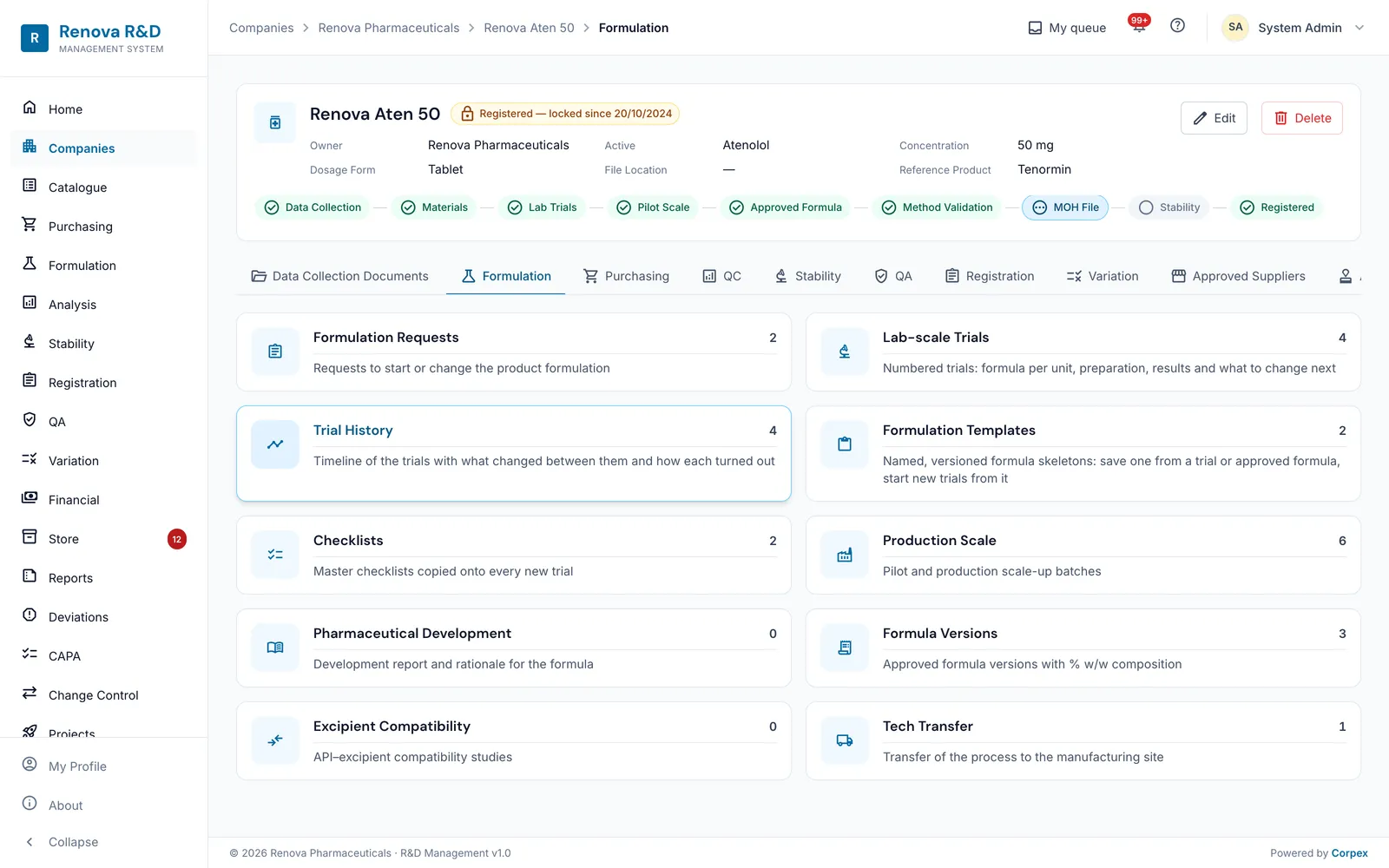
Each stage is decided from real records, such as three passing pilot batches or an approved validation. Registration locks the approved composition and methods.
Each department works on the same product record, so a formula, a method or a stability result entered once is the one the regulatory team cites.
Pick a module to see its screen. Every screenshot is taken from RENOVA-RDX running on demo data.
A product cannot start formulation until its references are in.
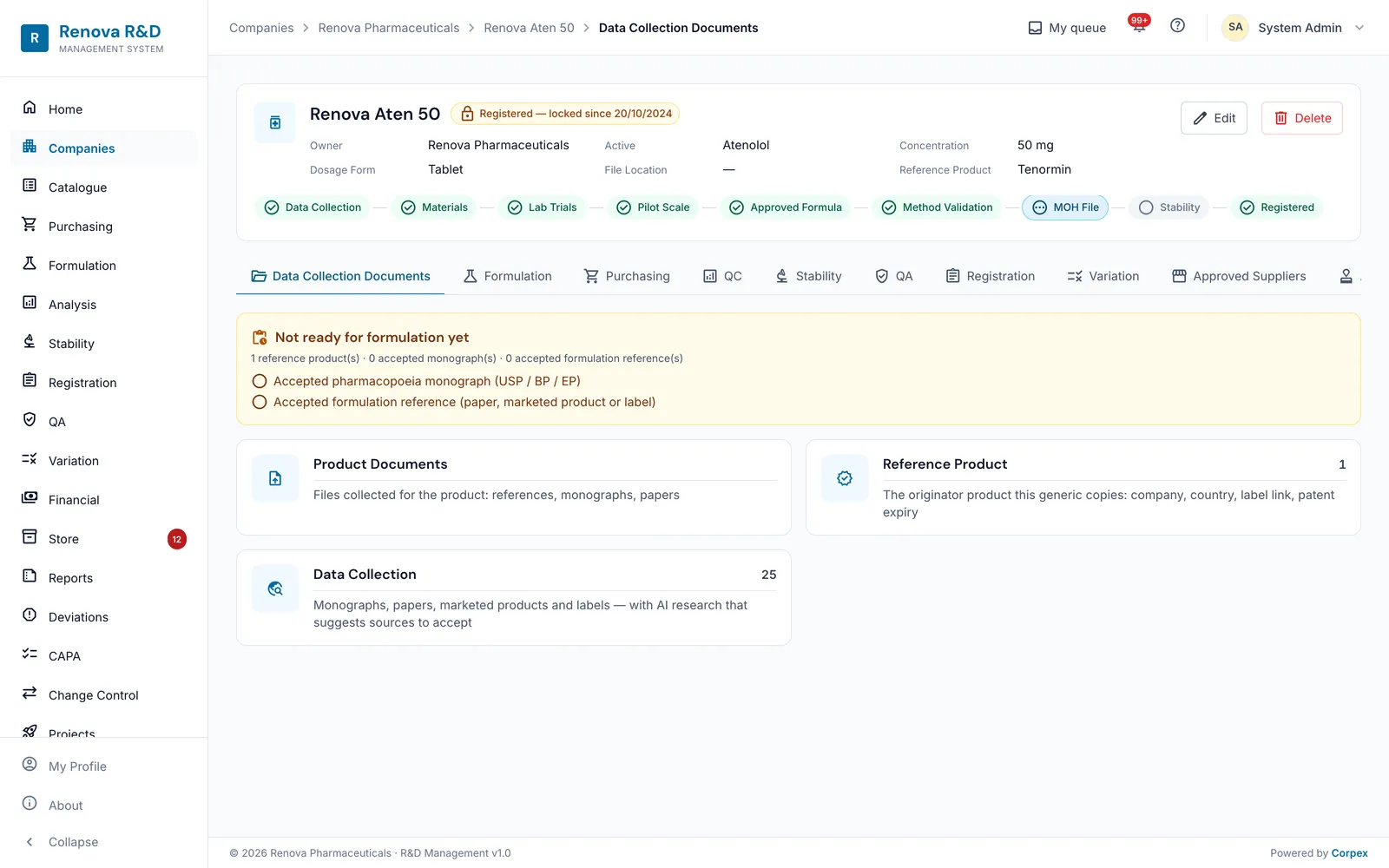
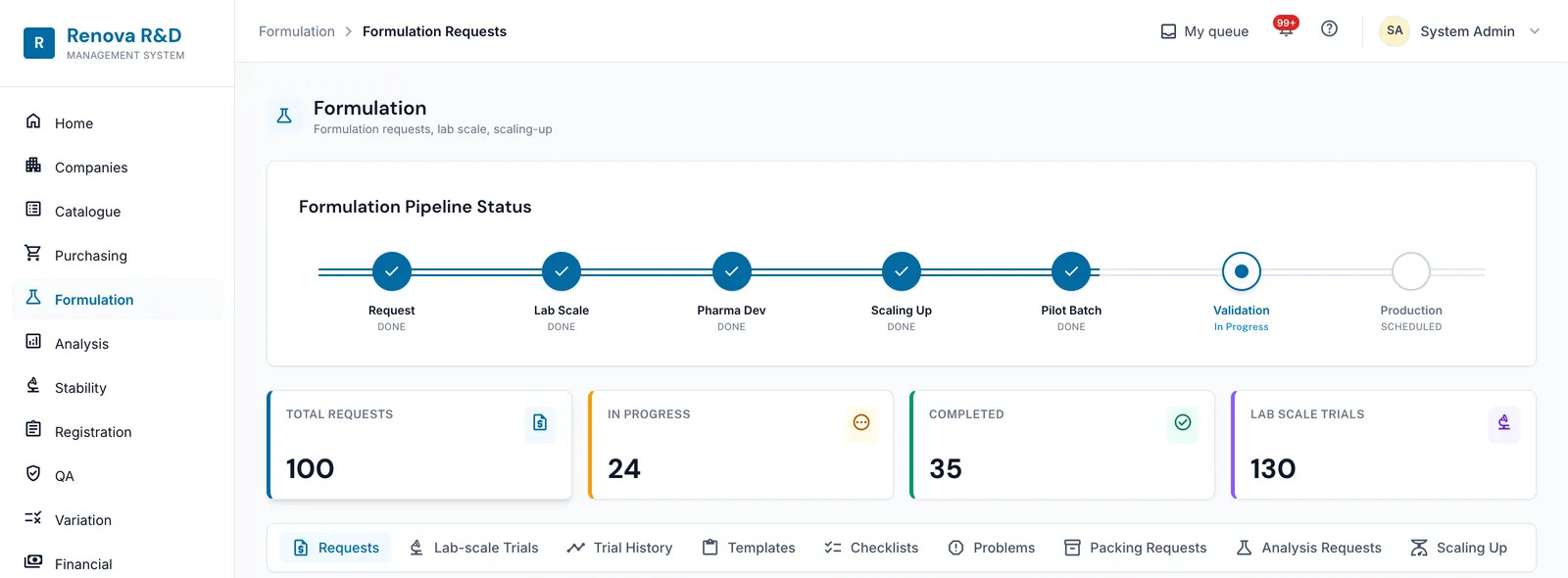
Numbered trials, scale-up and approved formula versions in one place.
Methods developed, validated and handed to QC on the same product.
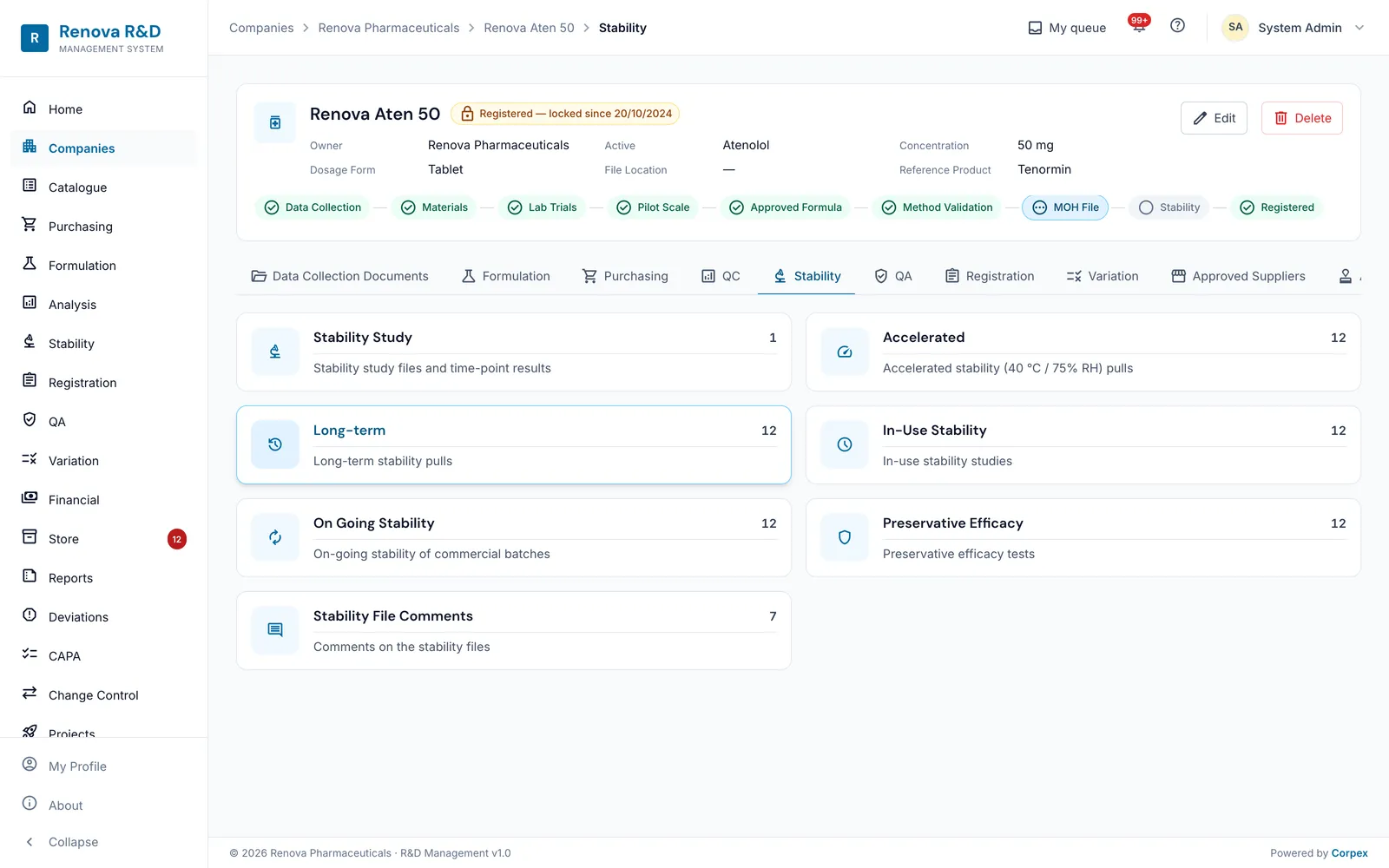
Studies, pull points and results checked against the specification.
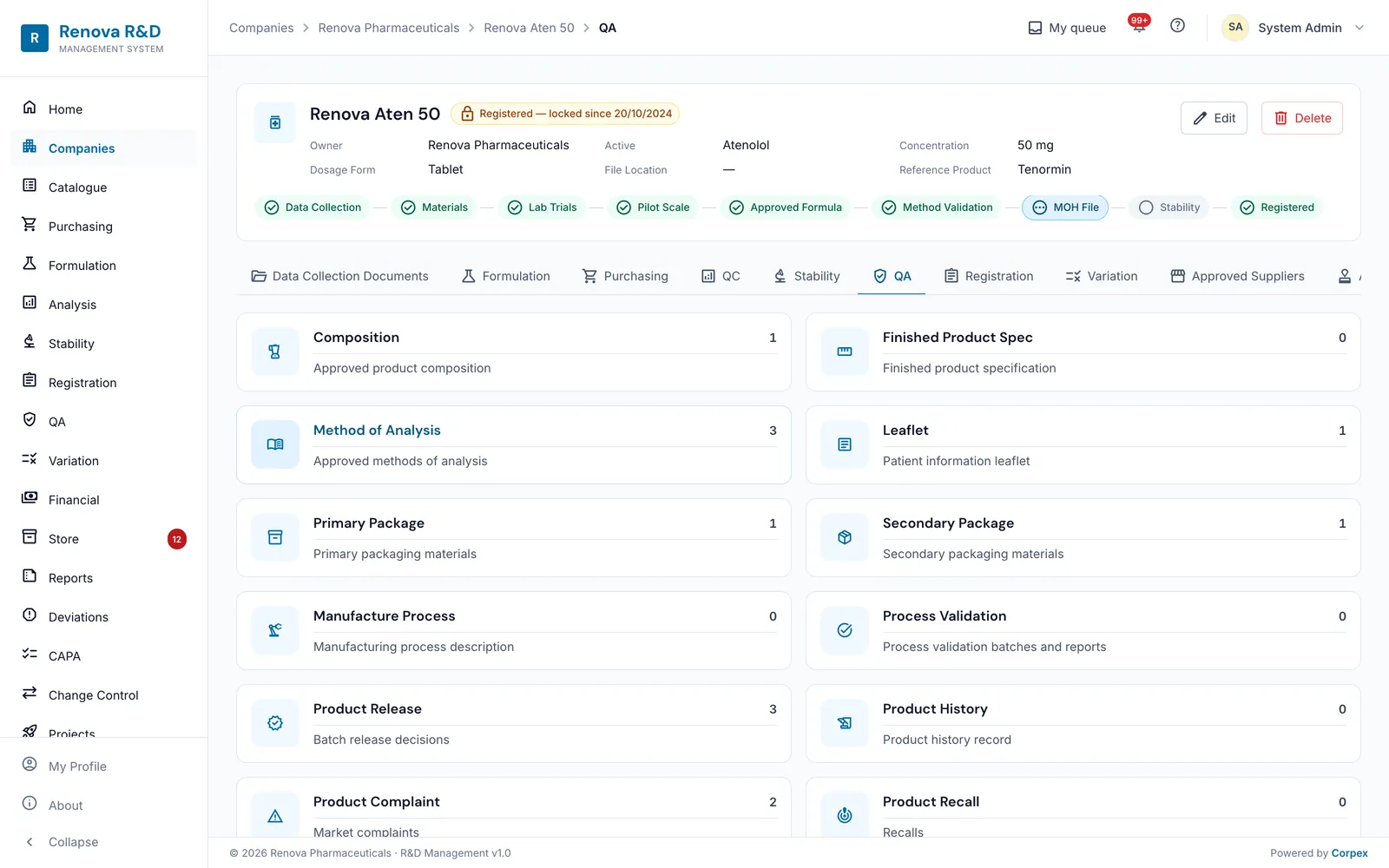
The approved product definition, and what happens to it on the market.
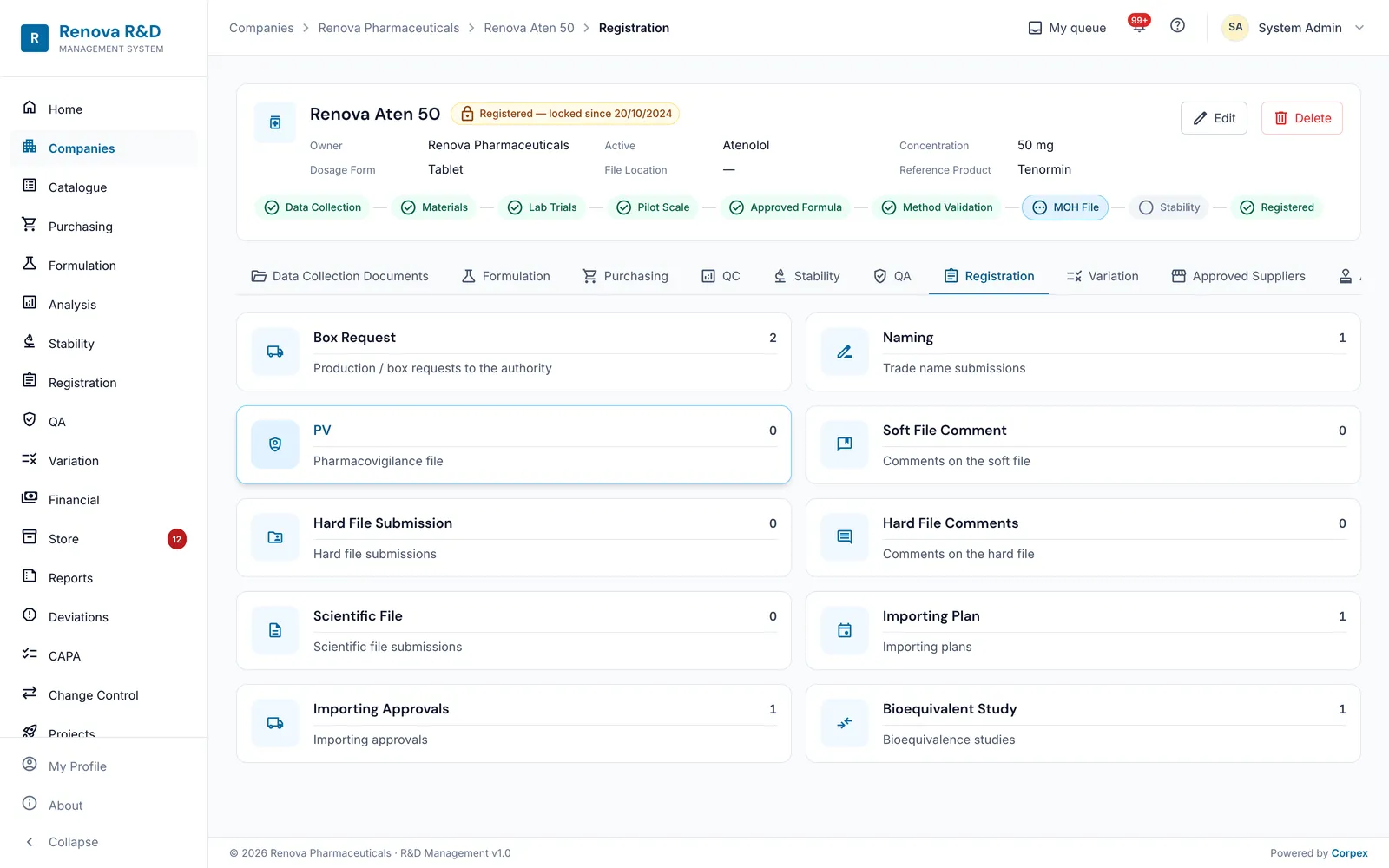
Every submission and approval for every market, on the product.
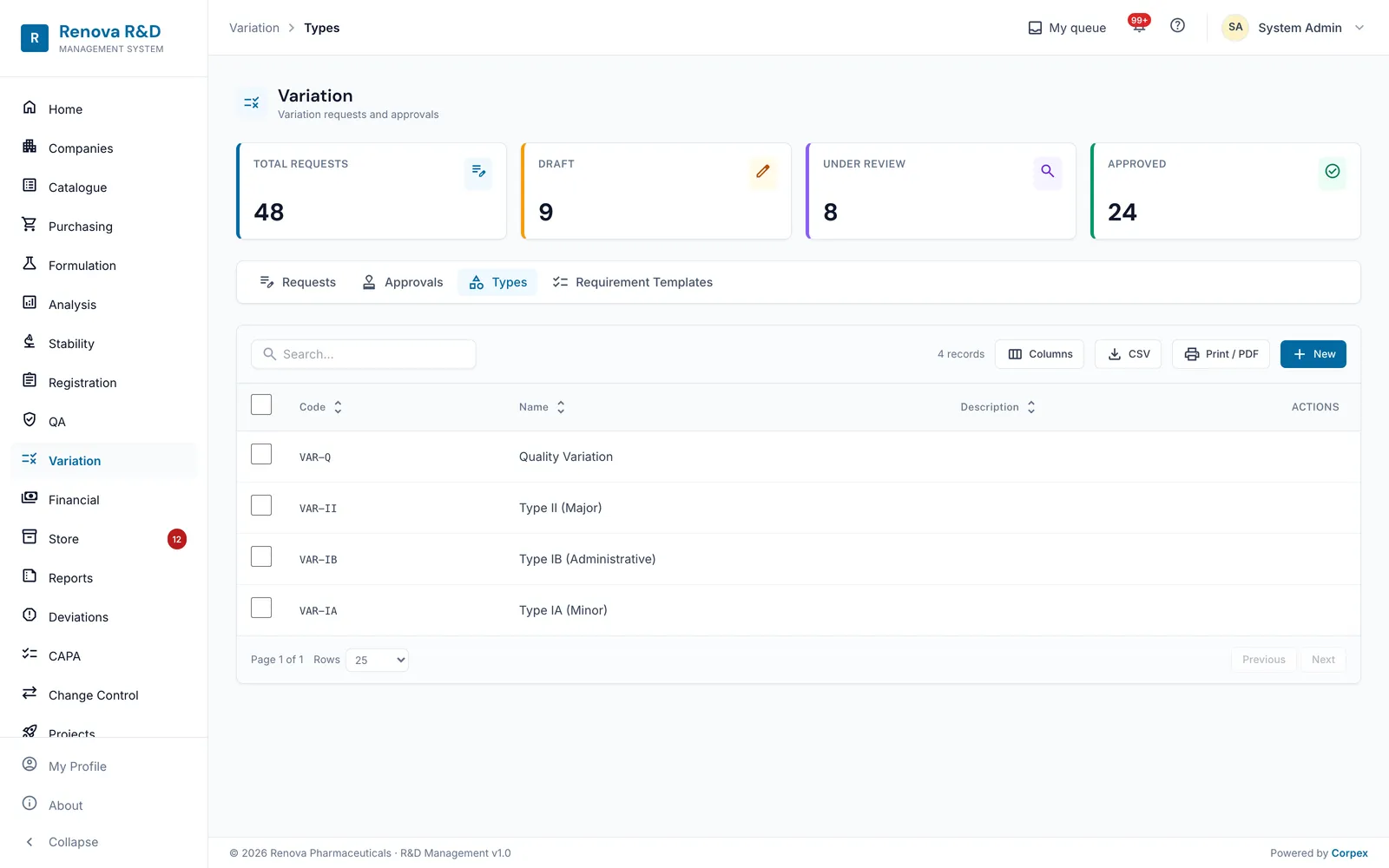
After registration, change goes through a variation, not an edit.
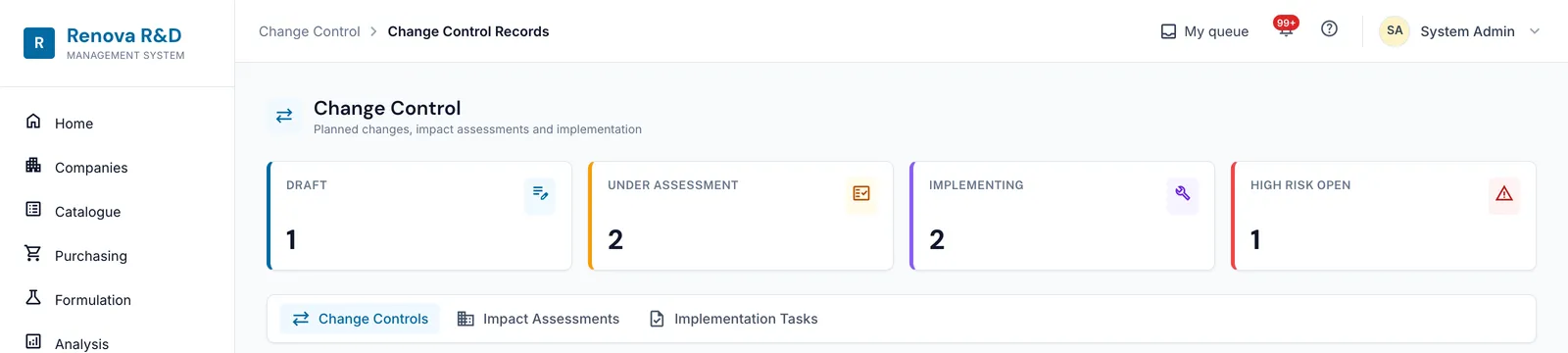
Deviations, CAPA and change control beside the R&D records they touch.
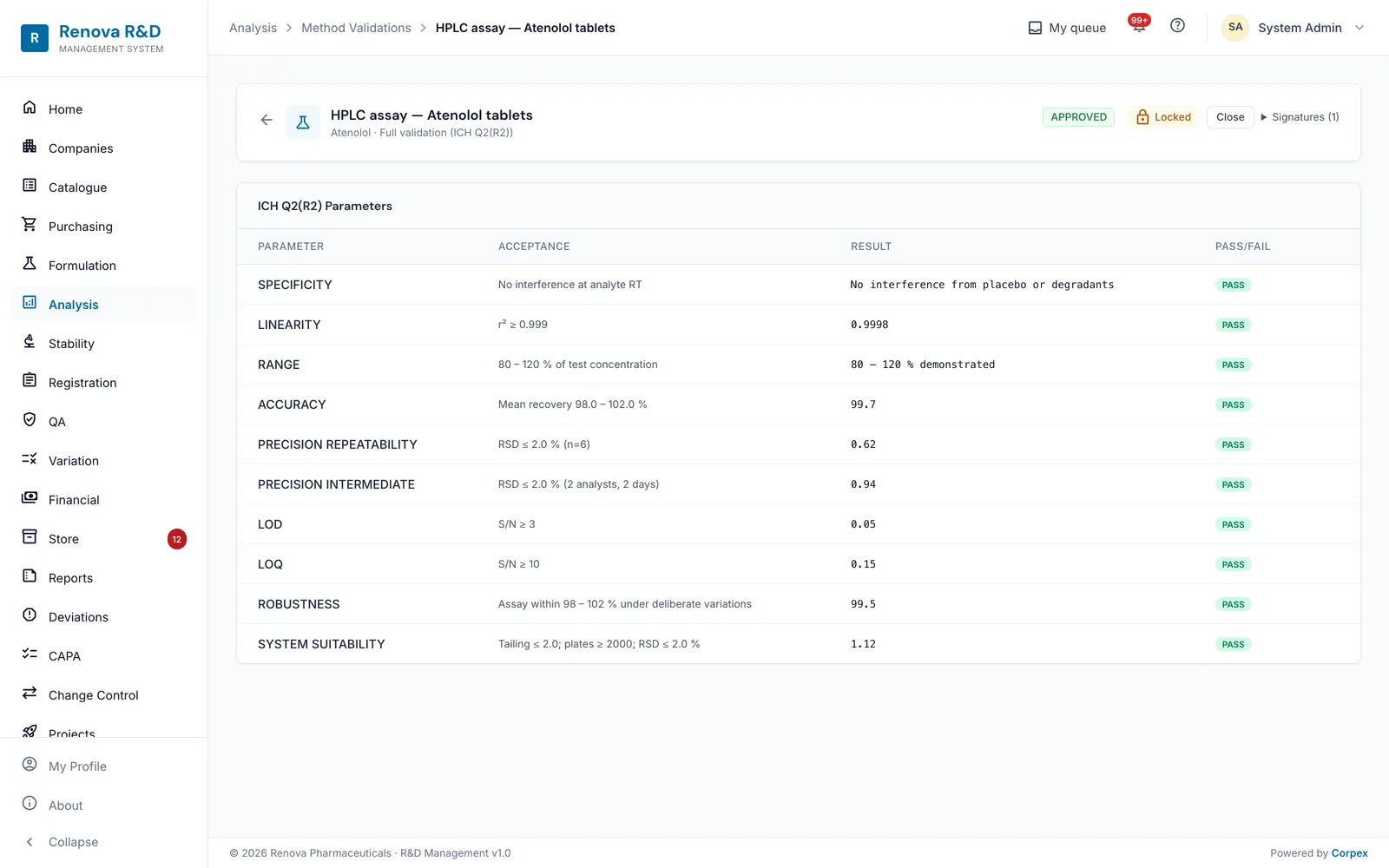
Each validation lists its ICH Q2(R2) parameters with the acceptance criterion, the result and a pass or fail. Once approved it is signed and locked, and the method of analysis it supports becomes read-only for QC.
Every time-point result is compared with the effective specification and with the trend of earlier points. Long-term data gives a shelf-life estimate, and a failing result can be sent back to formulation as a new formulation request.
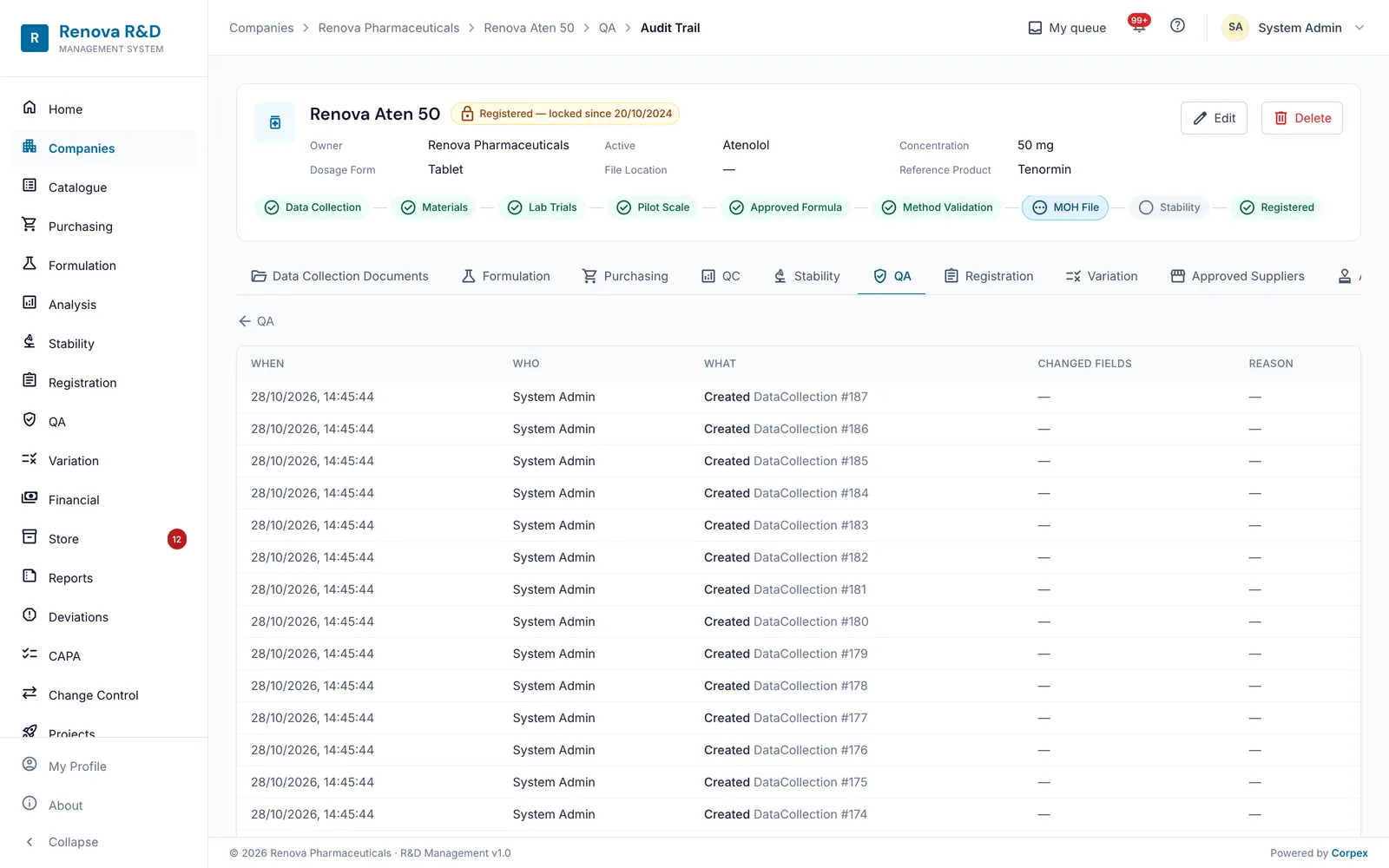
Every create, update and delete on a regulated record is written in the same transaction as the change, with the user, the time, the fields that changed and the reason. The product page shows its own trail.
Formula versions, the trials behind them and the pilot batches that passed sit on the same product the dossier is filed for.
Each method of analysis links to its ICH Q2 validation, and an approved validation is signed and locked.
Results are checked for OOS and OOT as they are entered, and the shelf-life estimate comes from the long-term data itself.
Once a licence is approved, composition and methods are read-only; a new version needs an approved variation.
The technical controls in RENOVA-RDX map to the regulations and guidelines below. Each card names the control that answers it.
Electronic records & signatures
Signing re-enters the password (and authenticator code when enabled), records the meaning and reason, and binds a hash of the record.
Computerised systems
Role-based access per module, an audit trail written in the same transaction as each change, and account lockout after repeated failed sign-ins.
Data integrity
Every write is attributed to a user and time, approved records are locked, and deletes keep the record with a reason instead of erasing it.
Stability testing and evaluation
Five study types, OOS and OOT flags on every result, and a shelf-life estimate with the Q1E extrapolation limit.
Analytical procedure validation
Validation parameters with acceptance criteria and pass/fail, plus a linearity regression with slope, intercept and r².
Common Technical Document
Each dossier starts with a Module 1–5 checklist and tracks its submission sequences and authority references.
Pharmaceutical development
Versioned development reports beside the trials, excipient compatibility studies and scale-up batches they summarise.
Pharmaceutical quality system
Deviations listed on each product, CAPA with an effectiveness check, and change control with impact assessments.
Registered = locked
An approved licence makes composition and methods read-only; a new formula or method version needs an approved variation.
Risk-based validation
Validated by the Corpex team with a risk-based approach and IQ, OQ and PQ documentation; see CSV services.
Compliance belongs to the validated system and the procedures around it. RENOVA-RDX supplies the technical controls, and the Corpex validation team documents them for your inspection. RENOVA-RDX tracks dossiers and sequences; it does not publish eCTD files to an authority gateway.
A registration dossier is only as good as the records behind it. RENOVA-RDX keeps those records with the product, works alongside CORPEX-LIMS for QC data and CORPEX eQMS for document control and change management, and is validated like any other GxP system through computer system validation (CSV). See the wider suite on the regulatory affairs software and pharmaceutical software solutions pages.
Dossiers are recorded per country and authority, so one product can carry national, regional and renewal filings side by side.
Products sit under their owner company, and every list can be filtered by company and product.
Runs on your servers or private cloud; configuration, data migration, training and validation by the Corpex team.
Book a demo and we will walk one product through formulation, method validation, stability and its dossier with you.
Request a DemoRENOVA-RDX is pharmaceutical R&D software that manages formulation, analytical methods, stability studies and regulatory affairs for one or more products across multiple dosage forms, so R&D and regulatory teams work from the same records instead of separate spreadsheets and folders.
RENOVA-RDX manages dossier compilation, registration tracking, renewal alerts and correspondence tracking with authorities, with eCTD support readiness built in. It does not publish to or submit through a specific health authority's electronic gateway — confirm the publishing and submission tools your target markets require with your regulatory team.
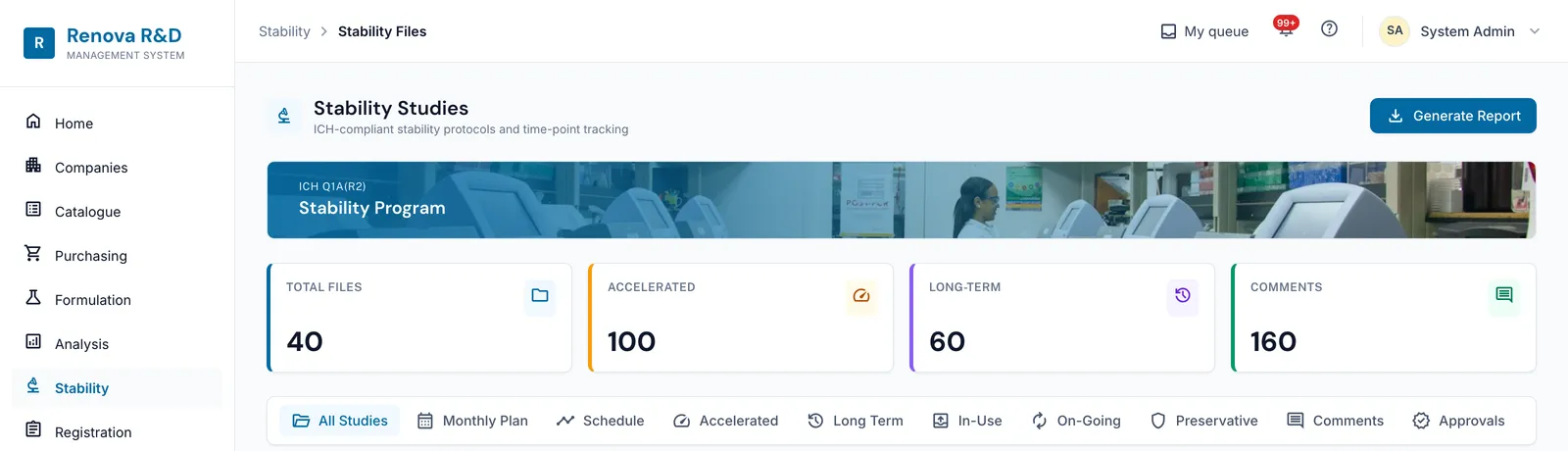
The Stability module schedules pull points and chamber monitoring, tracks degradation trends, and produces shelf-life data compliant with ICH guidelines — the evidence a CTD Module 3 quality section needs to support a claimed shelf life.
Yes. RENOVA-RDX is part of the CORPEX platform, so Certificates of Analysis and specification data from CORPEX-LIMS, and SOPs and change records from CORPEX eQMS, connect to the same product record without re-keying.
RENOVA-RDX implementations are validated through CORPEX's computer system validation (CSV) service — a Validation Master Plan, IQ/OQ/PQ execution and traceability from user requirements to test evidence — so the system is inspection-ready at go-live.
Yes. Dossiers are recorded per country and authority, each starting from the CTD Module 1 to 5 checklist with its submission sequences, while the Registration and Approvals tabs track naming, pricing, scientific and quality approvals and licences for whichever national authority the product is filed with.